Negative Amazon Reviews for $0: How Competitors Can Attack You for Free
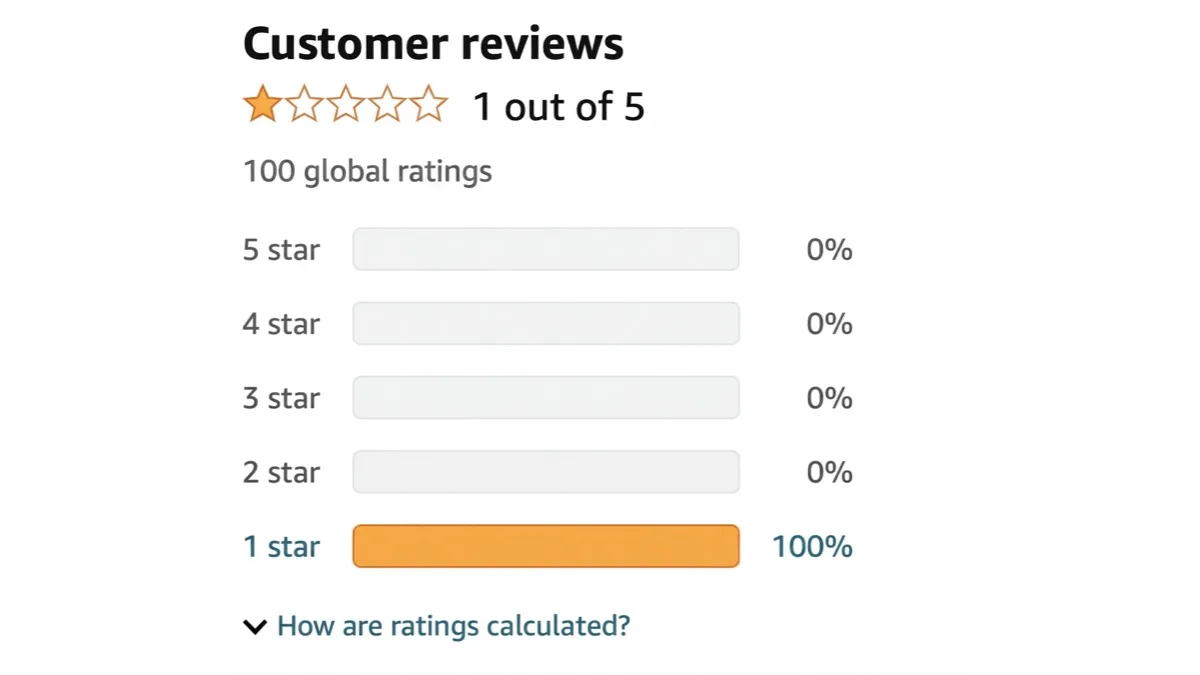
Almost everyone knows the traditional version of the problem: a seller pays for fake positive reviews.
But there is a more uncomfortable question for sellers:
What if someone could create a wave of angry customers around your ASIN without paying them to write negative reviews at all?
This is not a method we recommend, and it is not a blueprint for carrying out an attack.
It is an important defensive scenario because the environment that could make it possible already exists: fake-review brokers, post-purchase reimbursement groups, services operating through external websites, social media and messaging apps, and even marketplaces offering negative reviews against competitors.
Amazon itself said in October 2025 that a joint lawsuit with the Better Business Bureau targeted a website that sold, among other services, “fake negative reviews targeting competitors.”
What Do We Actually Know Is Documented?
First, the fake-review economy is not just something sellers discuss in forums.
Amazon describes “fake review brokers” as intermediaries who contact customers through their own websites, social media and, in some cases, encrypted messaging services, offering money, free products or other benefits in exchange for misleading content.
Second, there are public complaints from sellers who claim they have been targeted by coordinated one-star review attacks.
One seller on the Seller Central Germany forum wrote that they contacted a reviewer and claimed the reviewer admitted receiving money to leave a one-star rating.
In 2026, another complaint alleged that a cluster of orders and negative reviews appeared within unusually similar timeframes and geographic locations.
These are seller accounts, not independent investigative findings, so they cannot by themselves prove how widespread the phenomenon is.
But they do show the kinds of patterns sellers report.
There is also a more dangerous defensive scenario.
Someone impersonates the targeted brand inside a reimbursement group, encourages participants to buy the victim’s product based on a promise of reimbursement later, and then disappears.
The participants become angry and direct that anger toward the product or brand they believed was behind the offer.
The important point is that a network operating outside Amazon can connect your product name to expectations you never created — and leave you dealing with the consequences.
How Could a “$0” Review Attack Work From a Defensive Perspective?
Imagine the scenario only at a high level.
There is a group accustomed to offers such as:
“Buy the product, then receive reimbursement or another benefit after completing a condition related to the review.”
A malicious actor introduces an ASIN they do not own as part of a similar offer, or gives participants the impression that they represent the brand.
Participants buy the product expecting reimbursement outside Amazon.
Then the reimbursement never arrives.
At that point, the participant does not necessarily see an “unknown attacker.”
What they see is the product name, the Amazon listing and the brand they believed was behind the deal.
That anger can turn into returns, complaints, reports and negative reviews.
The mechanism changes the conflict from:
“Someone bought a negative review.”
to:
“A group of people believes it was scammed.”
That is where the phrase “$0” comes in.
Participants pay for the product first, while the victim may absorb returns or other operational costs.
The point is that, in this scenario, the attacker does not need to pay a traditional fee to every negative reviewer.
Instead, the attacker tries to turn other people’s disappointment into fuel against a competitor’s ASIN.
The Real Damage Is Not Just One Star
If a negative-review attack happens, the first thing sellers notice is usually the average star rating.
Commercially, however, the problem can be much broader.
A sudden cluster of reviews or returns can change the signal a buyer sees at the exact moment they compare products.
A newer product with 50 or 100 reviews is more sensitive to a small number of negative ratings than a product with thousands of reviews, simply because each new review represents a larger percentage of its visible history.
Suspecting an attack can also push sellers into making additional mistakes:
- responding emotionally;
- trying to contact reviewers outside the appropriate channels;
- buying positive reviews to offset the damage;
- accusing a competitor without evidence.
Those responses can create a new layer of risk on top of the original problem.
How Do You Tell the Difference Between a Product Problem and a Possible Attack?
There is no single sign that proves sabotage.
Repeated negative reviews may simply mean the product has a real defect or that something changed in a new batch.
The better approach is to think like a quality investigator, not to begin with a conspiracy theory.
- Start with the product itself: Are the same complaints appearing in returns, customer service cases or Voice of the Customer?
- Look at timing: Did an unusual wave appear within a short period compared with your normal baseline?
- Read the language, not just the stars: Are there identical phrases or details that do not match how the product is actually used?
- Document everything: timestamps, review links, screenshots, case IDs and any messages mentioning reimbursement or impersonation.
- Do not treat the mention of a competitor inside a review as definitive proof that the competitor is responsible. The reference itself could be part of the misdirection.
Amazon’s Community Guidelines currently provide a specific reporting path for sellers who believe a competitor has attacked their product: Seller Central, then Get Support or Account Health, followed by Report Abuse or the appropriate violation type.
Review compensation and individual reviews can also be reported through Amazon’s interfaces.
How Can You Protect Your Product From the Impact of an Attack?
The larger the review history and the longer the product has been established, the harder it becomes for a small group of new reviews to quickly redefine the overall picture.
A product with thousands of reviews and a long history is not in the same position as a new product with 30 or 50 reviews.
Building a genuine, long-term history of customers and reviews therefore does more than increase trust.
It also makes the product less fragile when a sudden wave of negative feedback appears.
Conclusion: Five Stars Alone Do Not Make You Untouchable
Even if your sales are strong and your product has five stars, that does not mean you are completely protected from a sudden wave of negative reviews.
The real strength is not only in the average star rating.
It is in the number of reviews, the age of the review history and the product’s long-term customer record.
The deeper that history becomes, the harder it is for a short-term wave to completely redefine your product in the buyer’s mind.
FAQ
Can a competitor buy negative reviews on Amazon?
Yes. There is documented evidence that some fake-review brokers have offered negative-review services targeting competitors.
Is the “$0” review attack a proven widespread method?
The sources provided document reimbursement networks and brokers offering negative reviews against competitors, but they do not establish how common this specific scenario is. Its relevance to sellers comes from the fact that the infrastructure required to make such a scenario possible already exists.
How do I report a competitor attack to Amazon?
Amazon’s Community Guidelines describe a Seller Central path through Get Support or Account Health and then Report Abuse or the appropriate violation type, together with relevant details and evidence. Proving who is actually behind an attack, however, can be difficult.
How can I reduce the impact of a wave of negative reviews?
The larger your genuine review history and the longer your product has been established, the less weight a small group of new reviews carries within the product’s overall visible history.