Amazon Buy Box: The Double-Edged Sword Behind Your Sales
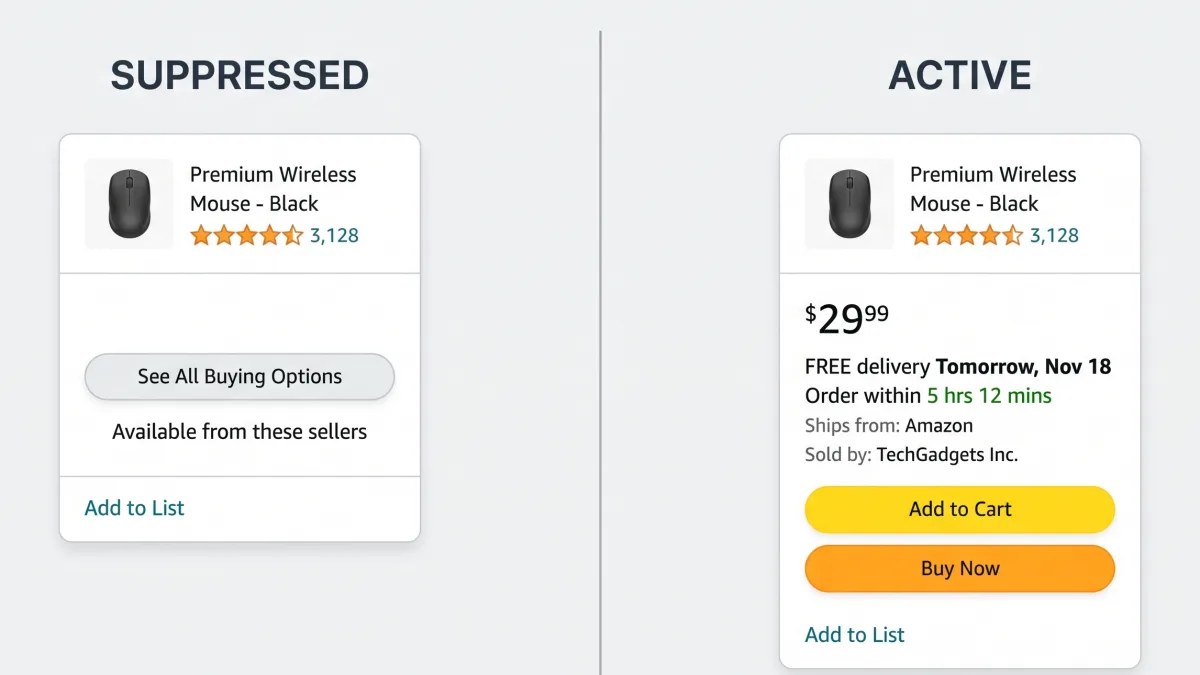
For an Amazon seller, pricing does not end with choosing the right number for a product page. The problem becomes more complicated as soon as the same product is sold through several channels: Amazon, a direct-to-consumer website, and perhaps other marketplaces such as Otto or Zalando.
At that point, it can make perfect economic sense to charge less in the channel that costs less to operate. But if a lower external price can weaken visibility on Amazon, pricing stops being a simple margin decision. It becomes a channel-strategy decision.
That is where the Featured Offer, historically known as the Buy Box, matters. It is not just a prominent purchase button. The offer occupying that position becomes the default path when a customer clicks “Add to Cart” or “Buy Now.” Losing that position can therefore change the economics of a product quickly, even when the seller’s offer remains technically available on the page.
Why do prices outside Amazon matter?
A multi-channel seller cannot assume that Amazon evaluates the price shown on Amazon in complete isolation from the rest of the market. One of the most commercially sensitive issues around the Featured Offer is the role of price competitiveness beyond Amazon itself, including prices on other marketplaces and on sellers’ own websites.
A lower price elsewhere can be relevant to Featured Offer eligibility or visibility. That relationship should not be treated as an automatic one-to-one rule in which every external discount immediately causes a seller to lose the Featured Offer. The commercial point is narrower and more important: external price competitiveness can matter to a seller’s position inside Amazon.
For a seller, that creates an obvious tension. Suppose a direct store costs less to operate than Amazon. Economically, the seller has room to pass part of that saving to the customer through a lower price. But if doing so can weaken the seller’s visibility on Amazon, the lower-cost channel may lose part of its ability to compete on price.
That is why multi-channel pricing cannot be managed as a set of independent spreadsheets. The price on a direct website, the price on another marketplace and the price on Amazon can become connected decisions.
Losing the Featured Offer is not a cosmetic change
A seller does not necessarily disappear when it loses the Featured Offer. Its offer may still be available. What changes is the path to purchase.
Instead of being the default option presented to the customer, the seller may move into a less prominent position while another offer becomes the primary purchase choice. Commercially, that is a very different situation.
For a business that depends heavily on Amazon, the pressure can be substantial. If a large share of sales flows through the default purchase path, protecting Featured Offer visibility may become more important than using lower costs elsewhere to offer deeper discounts.
This is why the Featured Offer is not merely a user-interface feature. It can influence how much freedom a seller feels it has across the rest of its distribution network.
From a written price-parity rule to algorithmic pressure
The debate over external prices did not begin with today’s algorithms.
In Germany, the Bundeskartellamt prohibited Amazon’s contractual price-parity clause in 2013. That clause had explicitly prevented merchants from offering lower prices through other online channels.
The commercial significance of that history is not the legal wording itself. It is the difference between a written contractual restriction and an economic effect produced through marketplace visibility.
If a seller is no longer contractually told, “You may not sell cheaper elsewhere,” but lower pricing elsewhere can still affect access to the most important purchase position on Amazon, the seller may feel similar pressure in practice: an external discount can carry an Amazon-side cost.
That relationship between external pricing and Featured Offer visibility remained a subject of regulatory scrutiny after the written parity clause was removed.
What changes in a multi-channel pricing strategy?
The biggest mistake is to treat price as a tool for winning sales inside each channel separately.
A seller operating across Amazon, a direct store and other marketplaces needs to ask a broader set of questions:
- What is the real margin in each channel after fees and operating costs?
- Can a lower-cost channel use that advantage to offer a lower customer price?
- What happens to Amazon sales if Featured Offer visibility weakens?
- Has one channel become powerful enough to limit what the company can do in its other channels?
These are not merely “Buy Box optimization” questions. They are questions about distribution structure and bargaining power.
The cheapest external price may not be the cheapest commercial decision
It is easy to say that a seller should charge less wherever its costs are lower. But a seller does not manage unit margin in isolation. It manages the economics of the entire sales network.
A discount on the company’s own website may look excellent on the order placed there. It becomes less attractive if it contributes to weaker visibility and materially lower demand on Amazon. The reverse can also be true: keeping prices aligned may protect Amazon volume, but it can prevent lower-cost channels from competing as aggressively on price.
That is the real tension. Featured Offer economics can turn an external pricing decision into an Amazon visibility decision.
The Featured Offer belongs in channel strategy, not only Amazon tactics
For a company that depends heavily on Amazon, winning the Featured Offer is an understandable objective. But it should not be measured in isolation.
If protecting that position means the direct store cannot use its lower cost structure, or another marketplace cannot pass lower fees on to the customer, there is a strategic cost that will not appear inside an Amazon sales dashboard.
A serious multi-channel seller therefore needs to watch three things together: price, visibility and channel dependency. Looking at only one of them gives an incomplete picture.
FAQ
Can a lower price on my own website affect the Amazon Featured Offer?
It can matter. External price competitiveness, including prices on sellers’ own sites and other marketplaces, can be relevant to Featured Offer eligibility or visibility. It should not be read as an automatic rule that every lower external price produces the same outcome in every case.
What does losing the Buy Box mean for a seller?
It means the seller’s offer is no longer the prominent default purchase option. The offer may remain available, but the path to it becomes less direct, which can have a significant commercial effect on sales.
What does Germany’s 2013 price-parity decision have to do with the Buy Box?
Germany prohibited a contractual clause that prevented merchants from selling cheaper elsewhere. The later debate shifted toward whether algorithmic visibility and Featured Offer eligibility can create similar economic pressure without the same written restriction.